As a licensed tax practitioner, one of the questions I get asked a lot is, “Can I claim my grandchild as a dependent?”
Naturally, I have to give my favorite answer: it depends.
The IRS has specific rules to determine who qualifies to claim a grandchild as a dependent. Let’s go over these qualifications.
Two Ways a Grandchild Qualifies
The IRS categorizes dependents into two groups. Your grandchild must meet the tests for one of these to be claimed on your return.
1. The Qualifying Child
To meet this definition, your grandchild generally needs to live with you and be under a certain age. This status is usually what triggers the high-valued Child Tax Credit.
2. The Qualifying Relative
If your grandchild is older or doesn’t live with you more than half the year, they might still qualify as a “Qualifying Relative” if you provide more than half of their total financial support.
Claiming a Grandchild as a Qualifying Child
Tax Code Reference: IRC §152(c) — Qualifying Child rules
To claim your grandchild as a Qualifying Child, you must be able to answer “Yes” to all of the following:
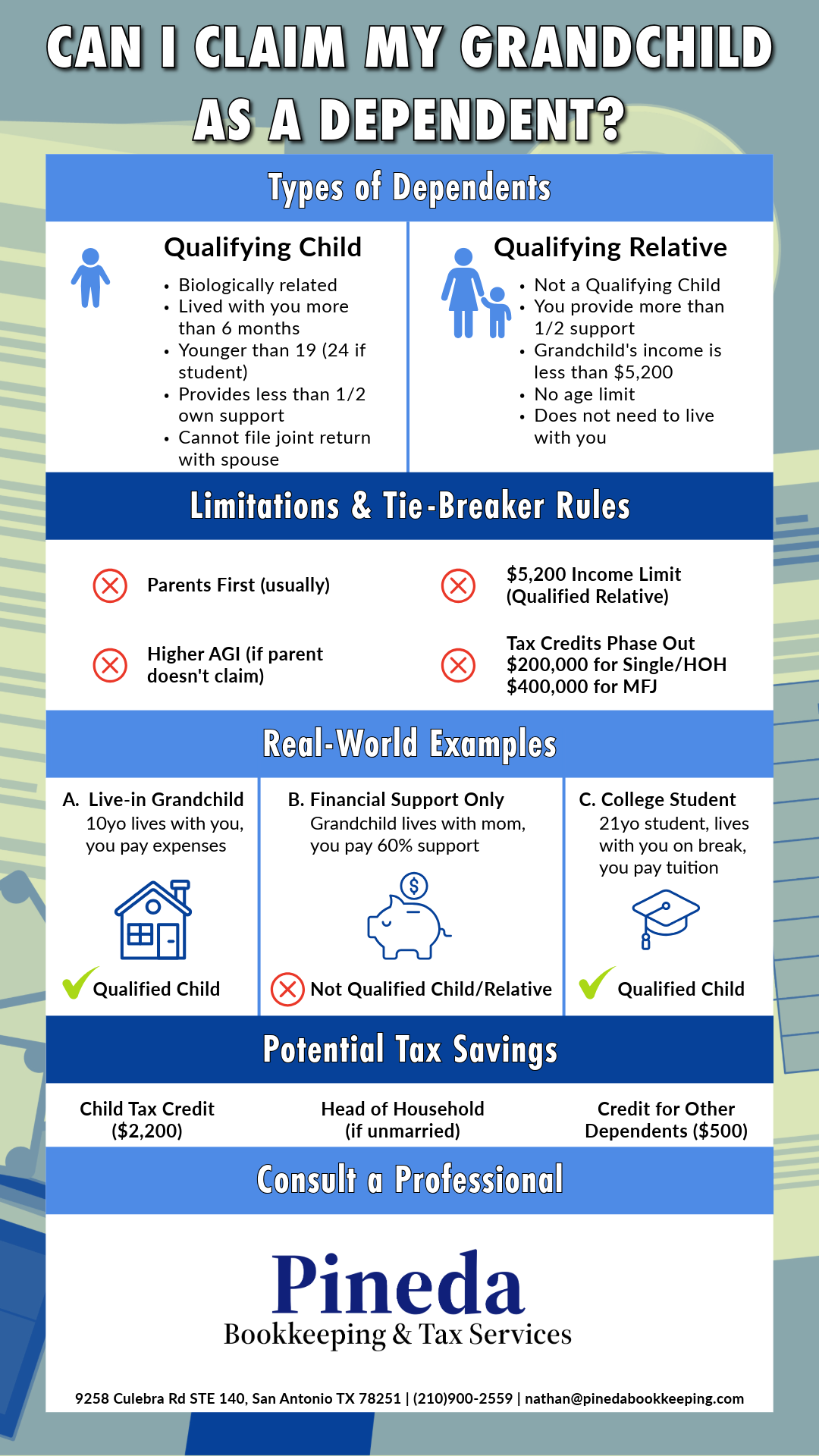
- Relationship Test: They must be your biological grandchild, step-grandchild, or legally adopted/foster grandchild.
- Age Test: They must be under age 19 at the end of the year, or under age 24 if they are a full-time student. (Note: There is no age limit if the grandchild is permanently and totally disabled).
- Residency Test: They must have lived with you for more than half the year.
- Support Test: The grandchild cannot have provided more than half of their own financial support.
- Joint Return Test: They cannot file a joint tax return with a spouse (unless it’s only to claim a refund of withheld taxes).
Pro Tip: If your grandchild was born during the tax year, they are considered to have lived with you for the “entire” year for tax purposes. provided your home was their home for more than half the time they were alive.
Limitations and “Tie-Breaker” Rules
Tax Code Reference: IRC § 152(c)(4) — Special Rule to 2 or More Who Can Claim the Same Qualifying Child
Things can get complicated if the grandchild’s parents also live in the same home. Generally, the IRS follows Tie-Breaker Rules to decide who gets the claim:
- Parents First: If a parent and a grandparent both try to claim the same child, the IRS usually gives priority to the parent.
- Adjusted Gross Income (AGI): If the parent chooses not to claim the child, the grandparent can only do so if their AGI is higher than the parent’s AGI.
- The $5,200 Limit: For a “Qualifying Relative” (someone who doesn’t meet the “child” criteria), the grandchild’s gross income must be less than $5,200 (for the 2025 tax year, subject to inflation).
Claiming a Grandchild as a Qualifying Relative
Tax Code Reference: IRC §152(d) — Qualifying Relative rules
What if your grandchild is 25 years old but lives with you while getting back on their feet? Or what if they live with the other parent, but you are the one paying for their housing, food, and medical bills?
In these cases, they may not be a Qualifying Child, but you can still claim them as a Qualifying Relative.
4 Requirements to be a Qualifying Relative
Under the definition of Qualifying Relative, your grandchild must meet these four criteria:
- Not a Qualifying Child: They must not meet the “Qualifying Child” criteria for you or any other taxpayer. If their parent is already claiming them as a qualifying child, you cannot claim them as a relative.
- The Gross Income Test: The grandchild’s gross taxable income for the year must be less than the exemption amount.
- For 2025: The limit is $5,200.
- For 2026: The limit increases to $5,300. (Note: Social Security benefits generally don’t count toward this limit unless they are taxable.)
- The Support Test: You must provide more than half (50%) of the grandchild’s total financial support for the year. This includes food, lodging, clothing, medical care, and education.
- The Relationship (or Residency) Test:
- As a Relative: Because they are your grandchild, they do not have to live with you to qualify under this test. You can provide support from afar.
- As a Non-Relative: If they weren’t related, they would have to live with you for the entire year. But for your biological or legal grandchild, the “Live-in” rule is waived.
What’s the Catch?
While this allows you to claim an older grandchild or one who lives elsewhere, the tax benefits are slightly different:
- No Child Tax Credit: Qualifying Relatives generally do not qualify for the $2,200 Child Tax Credit.
- Credit for Other Dependents: You can usually claim the $500 non-refundable credit.
- No EITC: Generally you cannot claim the Earned Income Tax Credit for a Qualifying Relative.
Real-World Examples
Example A: The Live-In Grandchild
- Scenario: Your 10-year-old grandson lived with you all year because his parents were working in another state. You paid for his food, clothes, and school supplies.
- Result: You can claim him as a Qualifying Child. You may be eligible for the $2,200 Child Tax Credit.
Example B: The Financial Support Only
- Scenario: Your grandson lives with his mother, but you pay 60% of his living expenses because his mother is struggling.
- Result: You cannot claim him as a “Qualifying Child” because he didn’t live with you. However, you might be able to claim him as a “Qualifying Relative” if his mother does not claim him and he meets the income limits.
Example C: The College Student
- Scenario: Your 21-year-old granddaughter is a full-time student. She lives in a dorm but stays with you during breaks (which counts as living with you). She has a part-time job but you pay for her tuition and rent.
- Result: You can claim her as a Qualifying Child because she is a student under 24 and you provide the majority of her support.
Why It Matters: Potential Tax Savings
Claiming a grandchild isn’t just about a “dependent” checkmark; it opens the door to:
- Child Tax Credit (CTC): Up to $2,200 per child.
- Credit for Other Dependents: A $500 non-refundable credit if they don’t qualify for the full CTC.
- Head of Household Filing Status: This offers a higher standard deduction and lower tax rates than filing “Single.”
Claiming a grandchild as a dependent can be extremely valuable—but it’s also an area where mistakes are common and IRS scrutiny is higher.
If you’re unsure, it’s worth seeing a federally licensed tax practitioner before filing.